
This post was published on Medium.
A total solar eclipse is among the most awe-inspiring events in nature, but relatively few people have had the opportunity to experience one.
This Q&A guide will help YOU find an opportunity to see an upcoming total solar eclipse.
For further information, be sure to download the FREE app “Totality by Big Kid Science” (sponsored by the American Astronomical Society) and read the book Totality! An Eclipse Guide in Rhyme and Science.
Q: What is a total solar eclipse?
A: A total solar eclipse occurs when the Moon passes directly in front of the Sun (from your vantage point), blocking the Sun from view so that it becomes dark enough to see the Sun’s faint atmosphere (the corona) along with planets and bright stars.
Q: How often do these eclipses occur?
A: On average, a total solar eclipse happens somewhere on Earth about every year and a half, but they are rare in any particular place. The map at the top (right) shows the paths of all total solar eclipses from 2017 through 2045.
Q: What does it mean to be on the “path of totality”?
A: The path of totality is the narrow path (like the ones on map above) in which a total solar eclipse will occur on eclipse day. If you are within the path, you’ll first see a partial eclipse in which the Moon will gradually (over about an hour) appear to take a larger and larger “bite” out of the Sun until totality begins. Totality will then last for between a few seconds to a few minutes, depending on the eclipse and your exact location. As totality ends, a partial eclipse will resume as the Moon gradually appears to move off the Sun.
Q: What if I’m not on the path of totality?
A: While the path of totality is quite narrow, a much wider region will experience a partial solar eclipse. For example, the figure below shows the regions in which a partial solar eclipse was visible during the 2024 eclipse over North America (along with the maximum percentage of the Sun that was blocked in each region). If you are not in the partial or total regions, you won’t see any eclipse.
Q: How do I know exactly what I’ll see and when the eclipse will occur at a particular location?
A: Use the free app, Totality by Big Kid Science. Choose your eclipse, then tap any location to bring up a box of local eclipse circumstances. If the location is in the path of totality, the box will tell you how long totality will last. If the location is not in the path, it will tell you the maximum percentage of the Sun that will be blocked from view. The box will also tell you the local times at which the eclipse begins, reaches maximum (or totality), and ends. Buttons at the bottom offer more details (and, in some cases, driving directions to the selected location).
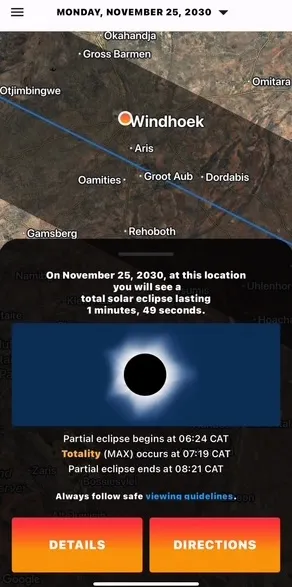
Screenshot from the Totality app, showing what you’ll see in Windhoek, Namibia during the 2030 eclipse.
Q: Is it really worth experiencing totality?
A: Yes! Imagine the day suddenly turning into night, even while the Sun is still high in the sky. For most of human history, such an event — a total solar eclipse — would have surely been frightening. Today, however, we can predict the exact times and locations of total solar eclipses centuries in advance, which means there’s no more fear, just an awe-inspiring spectacle of nature. Ask anyone who has witnessed totality in the past, and I guarantee they’ll tell you that it is worth your time and effort to get to the path of totality for an upcoming eclipse.
Q: Is there a “best” place to go along the path of totality?
A: Not necessarily, but there are at least three important considerations. (1) The length of totality; (2) the prospects for clear skies (since clouds can block your view of the Sun); (3) convenience in terms of how easy it will be for you to reach your chosen location. Eclipse chasers generally put priority on (1) and (2), but if you live on or near the path of totality, you might also put a high priority on convenience. Note: While you can easily watch an eclipse on your own, it’s often more fun to watch with a group, so I encourage you to look for eclipse events in the area where you plan to be.
Q: There’s an upcoming total solar eclipse near me, but I may be busy that day; can’t I just wait for the next one?
A: If you are lucky enough to have an eclipse coming anywhere near where you live, don’t miss getting to the path of totality. It will be worth the effort, since depending on where you live, there might not be another coming near you for a very long time.
Q: What will I need to view the eclipse safely?
A: An inexpensive pair of eclipse glasses makes it possible to look up at the Sun throughout theeclipse. (In fact, you can use eclipse glasses to look safely at the Sun at any time.) Just remember two key points: (1) Be sure that you get your eclipse glasses from a reputable source, such as those available through the Totality app Shop or any vendor listed at eclipse.aas.org/resources/solar-filters; (2) you should never look up at the Sun without youreclipse glasses except during totality, when you can and should remove them.
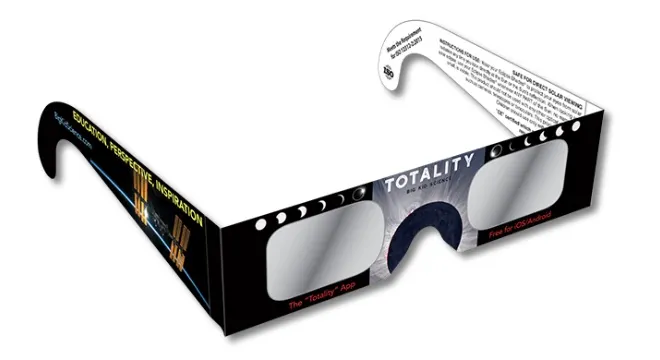
You can purchase eclipse glasses here.
Q: I live ON the path; what do I need to do?
A: Make sure that you: (1) won’t be traveling away from the path on eclipse day; (2) will have a clear view of the Sun during the eclipse; and (3) have eclipse glasses and follow safe viewing instructions as above. Note: You may wish to drive closer to the centerline, but I would say you will be fine staying put if you have a minute or more of totality.
Q: I live really close to the total path (e.g., I’ll have more than a 90% partial eclipse); should I still go to the path?
A: YES!!! You may be tempted to think that a 90% or 99% or even 99.9% partial solar eclipse will give you an “almost” total experience — but it won’t. Even at 99.9% partial solar eclipse, the sky is still hundreds of times brighter than it is during totality. That means you’ll miss the most incredible parts (like seeing the corona and stars/planets) unless you make the short drive to the full path. So be sure to check your location in the Totality app, and if you are within a reasonable drive of the path, plan ahead to make that drive.
Q: What should schools do?
A: First, check whether your school is on or near the path of totality; if it is “near,” then for the reasons above, try to find a way to get everyone to the path of totality on eclipse day. Beyond that, make sure that: (1) your school will allow all kids to be outside watching the eclipse, no matter whether the school is on the path of totality or will have only a partial eclipse; (2) the school has eclipses glasses on hand for all students; and (3) the school will excuse absences for kids who have an opportunity to travel to the path of totality. Note: If the eclipse happens outside of normal school hours, I’d encourage you to still host an eclipse watching event for the students, parents, and community.
Q: How can I learn more about eclipses and the science behind them?
A: There’s lots of eclipse information out there on the web, but I suggest starting with the information available on the Totality app Learn screen or by reading my book, Totality! An Eclipse Guide in Rhyme and Science. Note that both of those include setsof activities that parents or teachers can do with children.
Q: Can you tell us a little more about the book?
A: Totality! An Eclipse Guide in Rhyme and Science is a 32-page, full color book. Although aimed primarily at children (especially those in about grades 3 and up), the book can serve as a fairly complete introduction to eclipse science for readers of any age. Each page features a rhyming couplet that has been carefully constructed to serve as a mnemonic device for the science that is then explained through illustrations and “Big Kid Box” sidebars. The book concludes with a glossary, suggested activities, and an eclipse science summary. It retails for $19.99 (e-book $8.99); bulk discounts are available for schools or school districts.
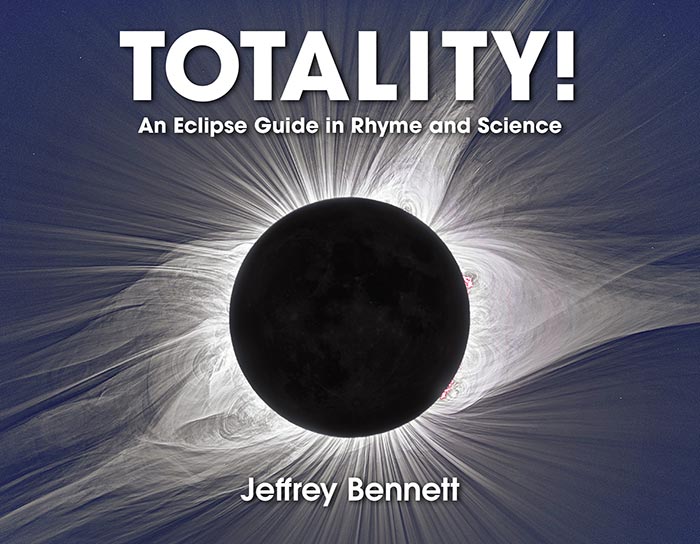
Totality! An Eclipse Guide in Rhyme and Science features a rhyming couplet on each page to serve as a mnemonic device for the science that is explained through illustrations and “Big Kid Box” sidebars. The book covers eclipses in general while focusing attention on the awe-inspiring spectacle of a total solar eclipse. The perfect companion to the free Totality app. Watch the author read the book here.
Q: Are you available to come talk to our community?
A: Yes. I frequently visit schools and speak to the public on a variety of science topics, and offer a “free visit program” to alimited number of communities. You can find details at www.jeffreybennett.com/events/.
Q: Regarding your book: Any chance you could get an astronaut to read it to us from the International SpaceStation?
A: So glad you asked! The amazing Story Time From Space program(storytimefromspace.com) has posted three videos in which astronaut Steve Bowen reads the rhyme from my book and conducts related science demos from the International Space Station. Be sure to check them out, and if you are a teacher, please share the videos with your students!
Press enter or click to view image in full size
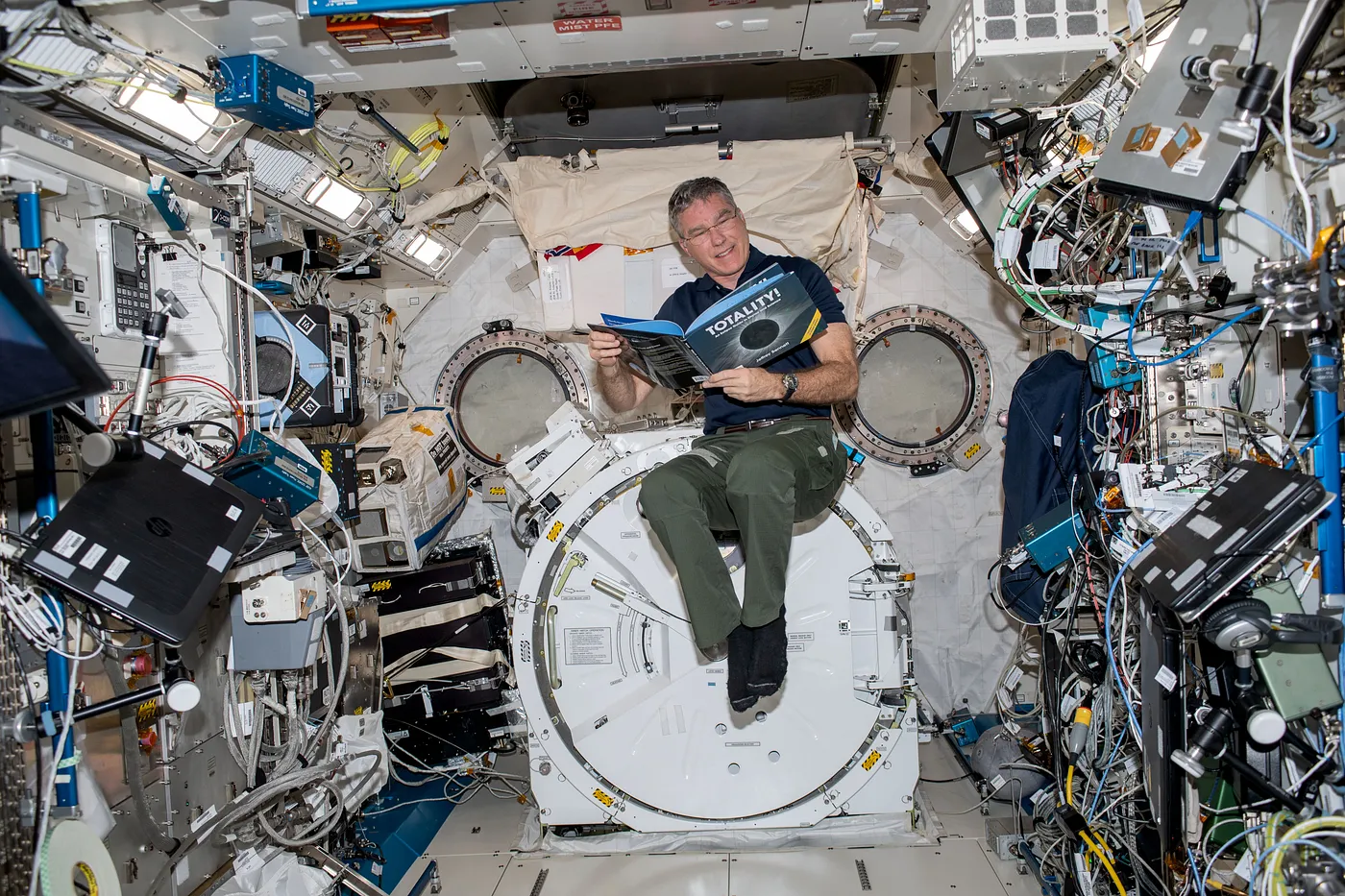
Astronaut Steve Bowen reads Totality! An Eclipse Guide in Rhyme and Science from the International Space Station.
Q: Why do you include a section on global warming within the Totality app?
There are actually four major reasons, which you can read about here, but in brief it is because science is science. With that in mind, I hope you will check out my book A Global Warming Primer — Pathway to a Post-Global Warming Future. It should be ideal for anyone who wants to learn more about the topic, as well as for many high school and college classes.
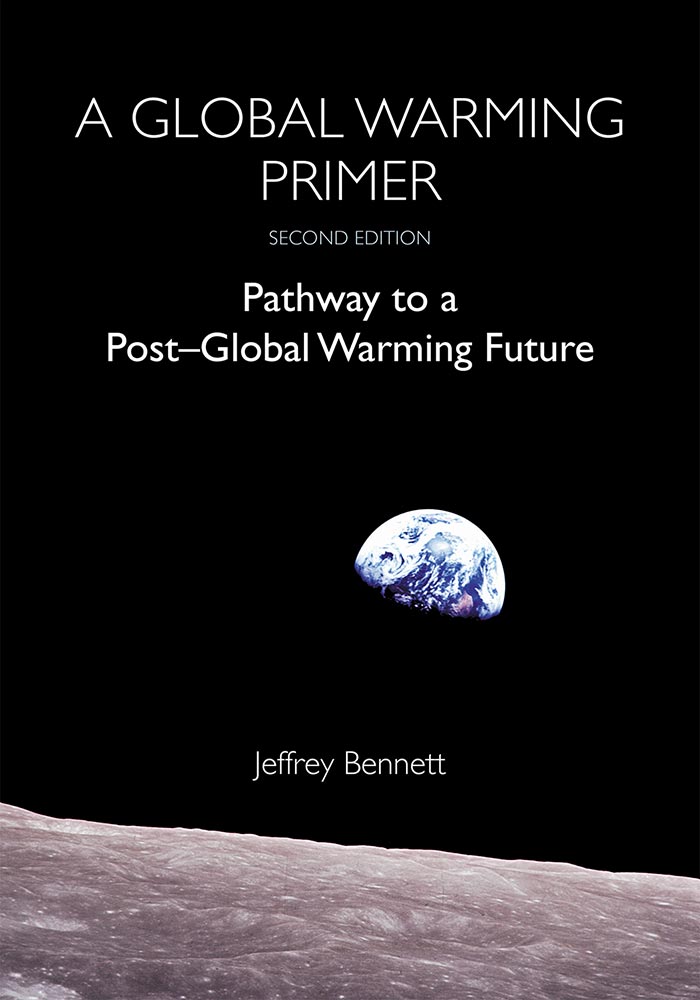
Our climate future may often seem a choice between bleak and bleaker, but it doesn’t have to be that way. This book, written largely in Q&A format, teaches the science, consequences, and solutions of climate change “with inspiration, not (only) fear.” The approach emphasizes that if we act rapidly and wisely, we still have a pathway to a future in which we may someday talk about global warming as a problem of the past. Ideal for high school and college classes that cover climate change and anyone wanting to learn more about the topic.
This Q&A is also available as a 2-sided PDF that you may feel free to copy and distribute. Click here to download.