
Dear Friends –
This year’s Geminid meteor shower will peak this weekend on the nights of Dec. 13 and 14, and it should be a good one. If you have clear skies, bundle up and go out and watch!
- For more details on this specific shower, see this Sky & Telescope article
- For general questions about meteor showers and how to view them, see the Q&A below, which is also posted on my Medium page.
Hope you get a great sky show, and best wishes for the holiday season.
Best,
Jeff
PS. Looking for holiday gifts? Please consider my books. Note: if you’d like autographed copies, be sure to order asap if you want them to arrive for the holidays.
Meteor Showers — A Brief Q&A for Understanding and Viewing Them
1. What is a meteor shower?
A meteor (sometimes called a “shooting star”) is simply the flash of light that we see as a small particle from space — typically sand grain to pebble size —burns up in our atmosphere. The flash occurs because these space particles enter the atmosphere at very high speed (up to about 150,000 miles per hour), creating enormous friction that makes the air they pass through glow with heat as a particle burns up. An estimated 25 million meteors occur somewhere around the world every day, which means that you are likely to see a few if you watch the sky for long enough on any night (at a dark, clear site).
A meteor shower means an unusually large number of meteors, so that you might see several to a couple of dozen meteors per hour. Because most meteors represent small particles ejected from comets, we see a meteor shower when Earth passes through the orbit of a comet that has shed a lot of particles over the past few thousand (or more) years. For example, the annual Orionids meteor shower occurs when Earth passes through the orbital path of Halley’s comet.
Note 1: “Shower” is a bit of an overstatement; even in the best meteor showers, you’ll be lucky to see much more than a meteor every couple of minutes. More commonly, you’ll see a few each hour.
Note 2: Most particles that create meteors burn up completely while still high in the atmosphere. If the particle is large enough (a pebble or small rock), it may make an especially bright meteor sometimes called a “fireball.” In some cases you may even see the fireball explode at the end as what is called a “bolide.” Very, very rarely, a space rock is large enough that it does not completely disintegrate in the atmosphere, and in that case pieces of it will hit the ground to make what we call meteorites.
2. How often does a meteor shower happen?
Because meteor showers occur when we pass through a comet orbit, and orbits stay the same year after year, the major meteor showers occur at about the same time each year. The table below (adapted from my textbook, The Cosmic Perspective) lists the major annual meteor showers and their approximate peak dates (which vary a bit from year to year), along with the comet associated with the meteor shower. As you can see, there are about 10 major meteor showers each year. How good a meteor shower will be in a particular year (that is, how many meteors you are likely to see) depends on details of the particle distribution in a comet’s orbital path. For example, we will see more meteors in a year when we pass through a part of the comet’s orbit that is relatively dense with particles than if we are passing through a part of the orbit that has few particles. (Note: all the particles along a comet’s orbit are orbiting the Sun along with the comet. Because comets typically take much longer than 1 year to complete an orbit — for example, Halley takes 76 years — Earth passes through a different section of the comet’s orbit each year.)
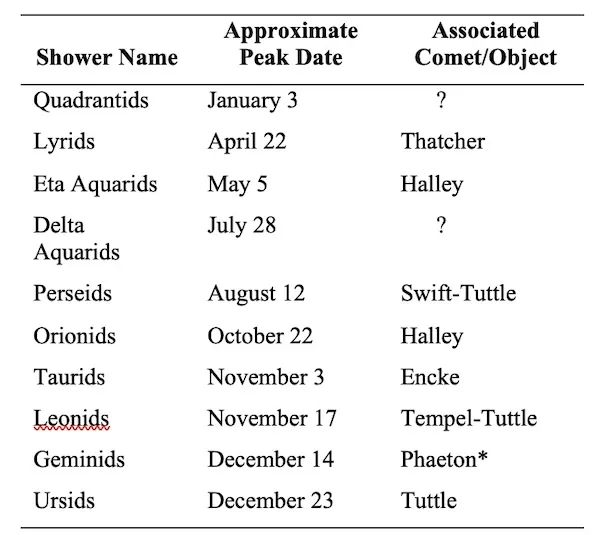
* Phaeton is classified as an asteroid rather than as a comet, but it sheds material in a “comet-like” way, hence creating the Geminids meteor shower. To learn more about this unusual case, see this EarthSky article.
3. When is the best time to observe a meteor shower?
For the date: You should check the news for the exact peak date of a meteor shower in any particular year, but note that meteor showers gradually build over several days (or more) prior to the peak date and then decline similarly afterward.
For the time of night: You may see meteors throughout the night, but because more meteors hit the Earth from the front than from behind (as Earth moves along its orbit), you can generally see more meteors in the pre-dawn sky than at earlier times of night. Still, it’s worth going out at most any time of night, and as someone who values my sleep, I typically watch in the evening before bedtime.
4. Are there specific locations that offer a better view?
A darker sky is always better, but as long as you have a clear sky that is dark enough to see at least some stars you will likely see at least a few meteors.
5. What direction should you look in to see a meteor shower?
Meteor showers get their names from the constellation from which most of their meteors will appear to come from. For example, the Orionids tend to be seen coming from the region of the constellation Orion and the Geminids from the region of the constellation Gemini. That said, you may still see meteors almost anywhere in the night sky.
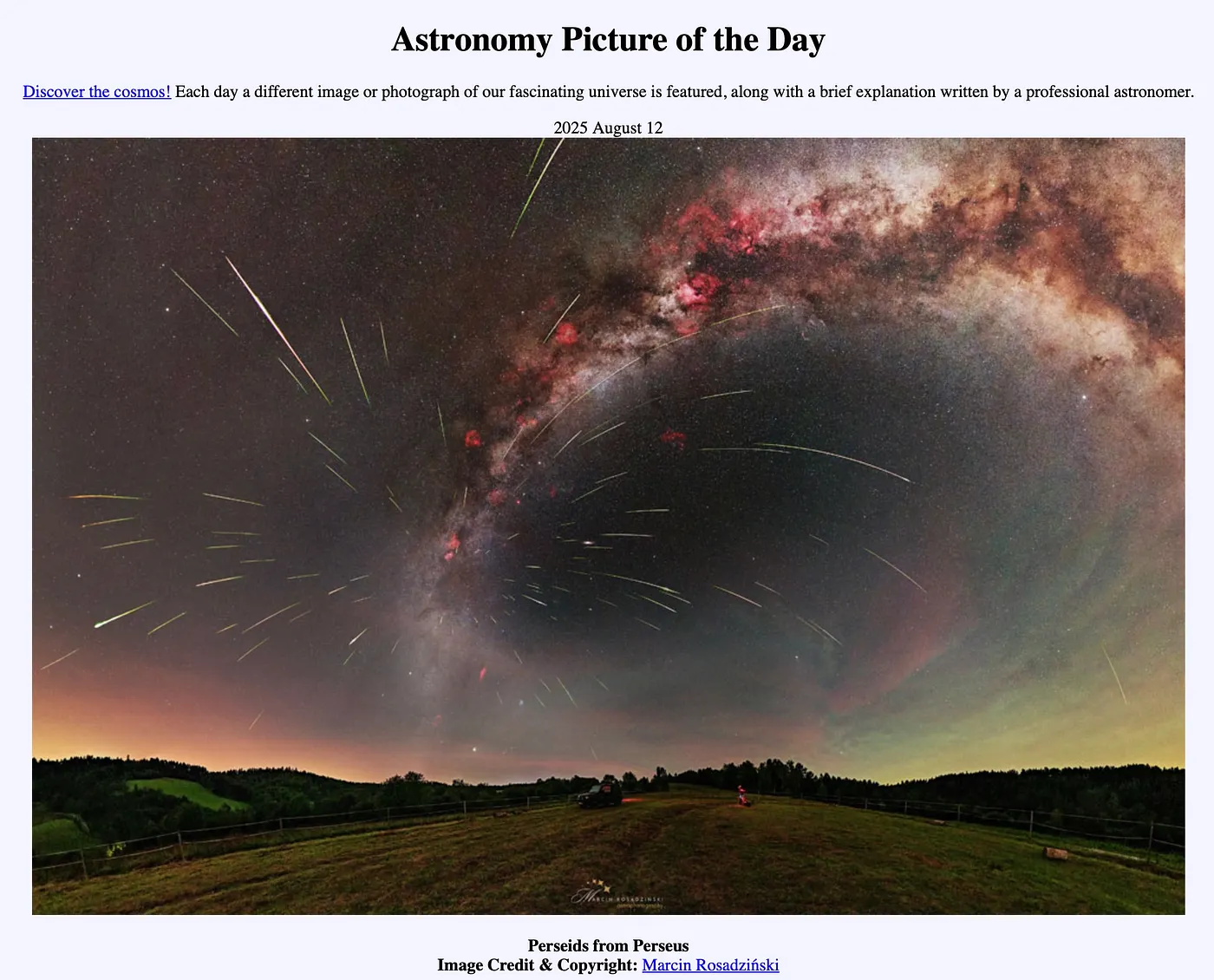
Note: You can find many great photos of meteor showers that will show how they appear to come from particular constellations at the fantastic Astronomy Picture of the Day web site (I check it every morning!); just go to apod.nasa.gov and use their search function (found below the “tomorrow’s picture” text) to search on “meteor shower.” For example, see this one from this year’s Perseids.
6. Do you have any tips for stargazers hoping to catch the shower in action?
You will want to sit back or lie down because you’ll want to watch for at least 15 minutes or more to have a good chance of catching a few meteors in the act. So be patient and try to keep a wide view of the sky, since you may catch some meteors with your peripheral vision. Be sure to dress warmly enough so that you can remain comfortable as you watch.
Note: The fact that you want to watch a wide region of the sky means no equipment is needed. That is, no binoculars, no telescopes, etc. If you want to try to photograph the meteor shower, you will need long exposures with a wide angle view of the sky and your camera pointing in the general region of the radiant constellation (the one that gives the shower its name). For more details, look up “how to photograph a meteor shower” online.
7. What else should I know about the relationship between comets and meteors?
People sometimes confuse comets and meteors, because photos of both can look similar. But they look quite different when you actually see them:
- As above, a meteor is a flash of lightin our own atmosphere, created as a piece of space dust or a small space pebble/rock burns up. Hence,meteors are visible for only a few secondsas they dart across the sky.
- Comets are in space, orbiting the Sun. This means that even the rare ones that come close enough for us to see are still typically tens to hundreds of millions of kilometers from Earth. As a result, their motion relative to the stars is fairly slow, so that on a single night, you may not notice this motion at all; the comet will simply rise and set with the stars. In other words, even though comet photos may make it look like they are racing across the sky, they aren’t; on any particular night that the comet is visible, you’ll simply see it with its long tail sitting in one spot among the stars in the sky.
Remember that, despite these differences, there is a deep connection between comets and meteors: Most of the particles that enter our atmosphere to become meteors were shed by comets.
8. What would you say is the coolest thing about seeing meteors flashing across the sky?
Most comets are remnants from the time when our solar system first formed about 4½ billion years ago, which means that the particles that we see as meteors also come from that time. This means that when you see a meteor, you are witnessing the disintegration of a particle that has traveled through space for some 4½ billion years just to give you this final show.