
This post was published on Medium.
Many people across the U.S. (and elsewhere) have had a great opportunity to see the aurora over the past two nights. If you’ve missed it — or want to see it again — there’s a good chance for tonight (Thursday, Nov. 13) as well. And there will likely be other chances over the next couple of years (and beyond). Here is a very brief guide to viewing and understanding the aurora.
Where to see it: Typically, the aurora is only visible at very high latitudes (such as northern Canada and northern Europe), but on occasion it may be visible as far south as about 35°N (or even farther south).
How to see it: If it is visible in your area, just go out any time after dark and look toward the north. Of course, you’ll see more if you go to a site with darker skies. If you don’t see it by eye (but you have heard it is visible in your area), try taking a photo with your phone, which will pick up fainter light than your eyes will detect. You may end up with a great photo of the aurora even though your eyes don’t see it. Here’s a photo my wife took from Beaver Creek, Colorado.
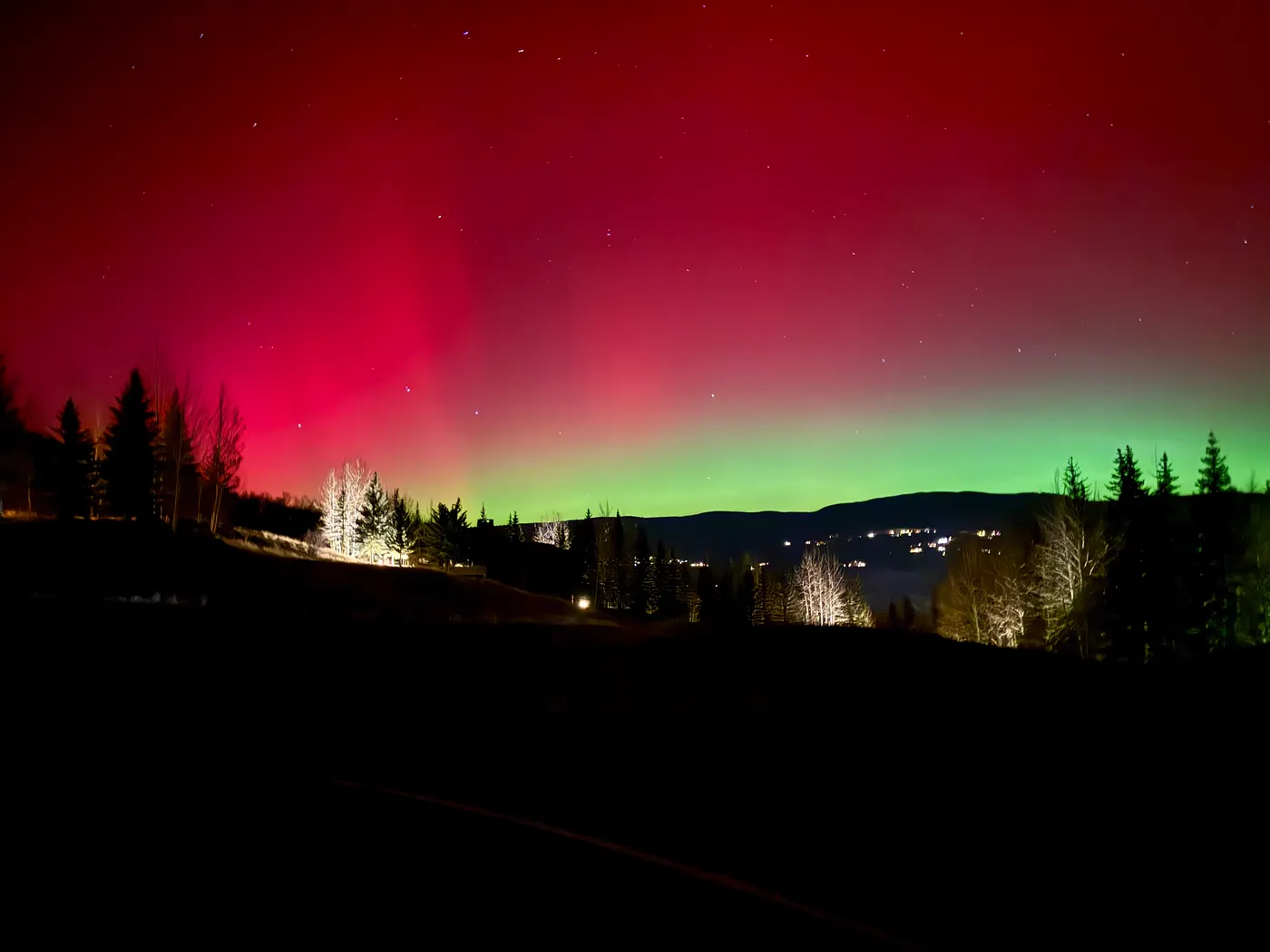
Aurora viewed from Beaver Creek, Colorado, November 11, 2025 (Lisa Bennett)
How do I know if it is visible in my area? The local news is likely to tell you, and there are a number of apps and web sites you can check as well. A couple of my personal favorites:
- Website: www.spaceweather.gov. About halfway down the page look at the box titled “The Aurora” and press play on the “aurora forecast” animation. This will show you where the aurora is expected to be visible tonight. Note: Because the animation shows an “overhead” view, the aurora may well be visible at somewhat lower latitudes than this view may seem to imply.
- App: Thanks to a recommendation I heard on NPR, I just downloaded the “My Aurora Forecast” app, which I really like. There is a free version, or you can pay $3.99 for the ad-free “pro” version.
What causes the aurora? In brief, the aurora is caused by charged particles (mainly electrons) from the Sun that collide with atoms and molecules in Earth’s atmosphere. The charged particles are channeled toward the poles by Earth’s magnetic field. Therefore, there are two auroral rings: The aurora borealis, or northern lights, and the aurora australis, or southern lights. Both auroral rings are almost always present but are usually confined to high latitudes (both north and south). The following diagram (screenshot from first video link below) shows the idea with the two auroral rings labeled.
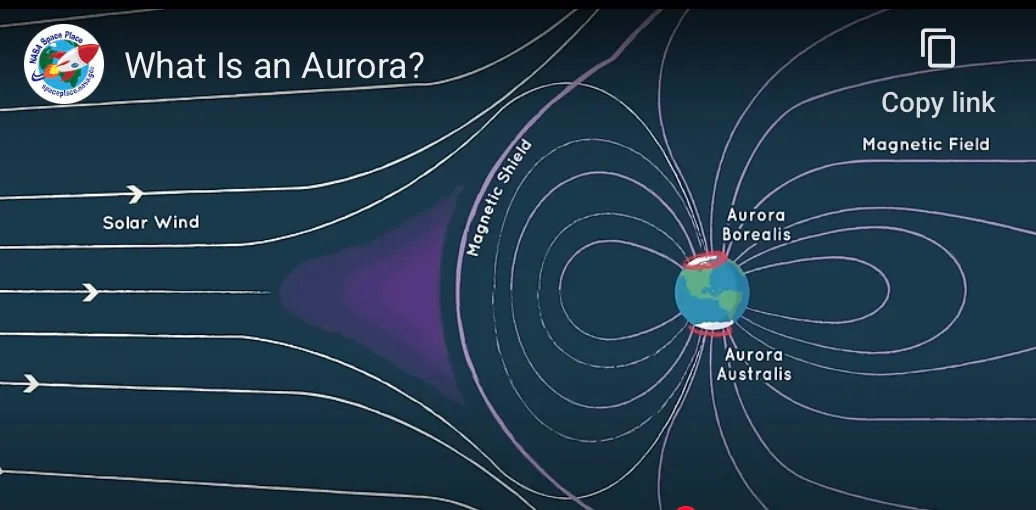
This screenshot (from this NASA video) shows how particles flowing from the Sun (the solar wind) are redirected by Earth’s magnetic field, leading to the creatio of the two labeled auroral rings.
Note: if you are wondering why you hear much less about the aurora australis, it is because the southern hemisphere has very few populated areas at latitudes where it is typically visible. In contrast, the aurora borealis is often visible to populated areas in Canada and northern Europe.
Why is the aurora sometimes visible at lower latitudes? While numerous factors can affect the aurora, the key is the flow of particles coming from the Sun, which is enhanced after a significant “solar storm” — which typically means some sort of eruption of hot gas (plasma) from the Sun’s upper atmosphere, or corona — especially if it leads to what is called a “coronal mass ejection” (or CME). The following photo is an x-ray image of a solar eruption that led to a coronal mass ejection in 2012 (image from the Solar Dynamics Observatory spacecraft, with Earth shown for scale).
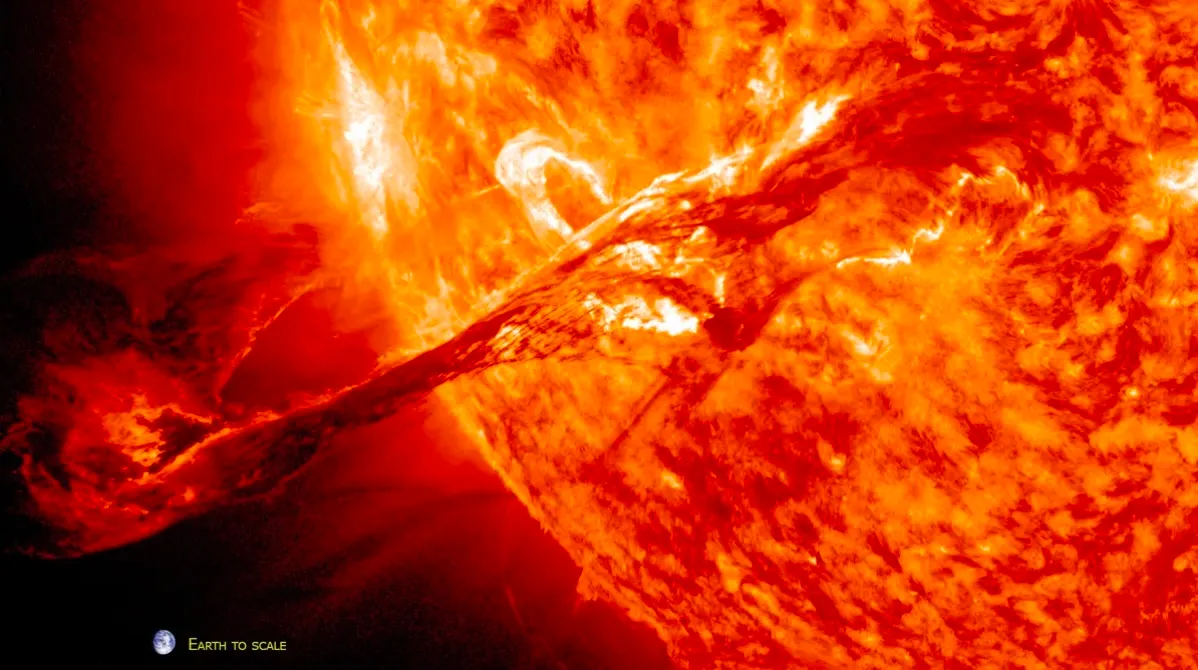
This solar eruption (seen in x-rays) led to a coronal mass ejection. Photo from the Solar Dynamics Observatory (2012).
When are solar storms (that can cause strong auroras) most likely? Solar storms can occur at any time, but are more likely when the Sun is more “active.” Solar activity varies in an approximately 11-year cycle, so solar storms and strong auroras are more common near the peak of a solar cycle, known as “solar maximum.” We happen to be near a solar maximum right now in 2025, which explains why the recent auroral activity is not too surprising.
Note 1: While solar “activity” varies significantly with time, the total amount of energy we receive from the Sun (as sunlight) is remarkably steady, varying by much less than 1% over many centuries. Solar activity all occurs at and above the Sun’s visible surface, and is manifested by such things as sunspots, solar flares, and other solar storms. In contrast, the total energy coming from the Sun is generated deep in the Sun’s core, where it is unaffected by activity at the Sun’s surface.
Note 2: The fact that the Sun’s total energy output does vary slightly (as above, by much less than 1%) makes some people wonder if the Sun could have anything to do with global warming. The answer is a clear no; for details, see the section titled “Could the Sun be the cause of the observed global warming?” in my book A Global Warming Primer, which you can find posted online here. As explained in the book, there is no reasonable doubt that global warming is caused by us, primarily through the use of fossil fuels.
What causes the different colors of the aurora? The colors depend on which atoms or molecules in Earth’s atmosphere have been “excited” as a result of a collision with a charged particle from the Sun (and on the particular amount of energy in the collision that causes the excitation). The following chart shows the major colors (from www.timeanddate.com/news/astronomy/solar-maximum-aurora-colors; see that page for more detail on the different colors and why they vary with altitude).
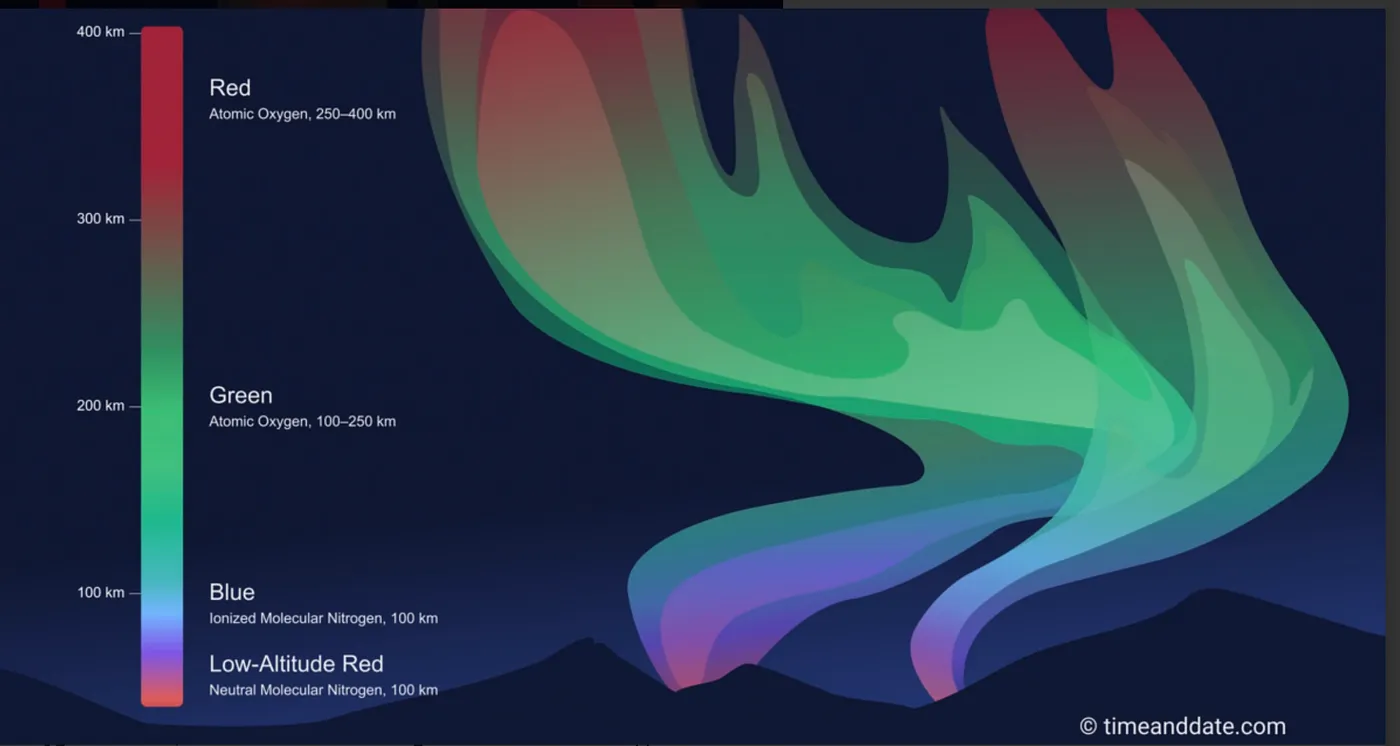
Aurora color chart from from www.timeanddate.com/news/astronomy/solar-maximum-aurora-colors.
Does the aurora have any effects on humans? Yes, but not on our physiology (though seeing it can be a very emotional experience). However, it can affect our civilization because the solar storms that cause auroras can in some cases damage electronics. In particular, there have been times when solar activity has caused disruption or damage to satellites, navigational systems, radio communications, power grids, and more.
Do humans have any impact on the solar activity that causes auroras? No. The Sun is so enormous in comparison to Earth that that nothing that happens here on Earth (whether or not it is caused by humans) can have any significant effect on the Sun. Note: If you’d like to understand scale comparisons more generally, please look for my forthcoming book The Scale of the Universe (bigkidscience.com/scale).
Want to learn more about auroras? Here are a few recommended sites:
Short videos: I really like both of these:
3 minutes from NASA (and source of screenshot above)
4 minutes from the Canadian Space Agency
NOAA’s “aurora tutorial”: www.swpc.noaa.gov/content/aurora-tutorial
NASA’s aurora guide: science.nasa.gov/sun/auroras/
NASA Space Place for kids (source of first video above): spaceplace.nasa.gov/aurora
Aurora explanation from “Time and Date”: www.timeanddate.com/astronomy/northern-southern-lights.html
Hope you’ve found this useful!
Please check out my books at www.BigKidScience.com