
This post was published on Medium.
Launch of Artemis II (April 1, 2026). If you view it on Youtube you can use the view tools in upper left (or just move your cursor around) to keep the rocket in the frame as it rises.
With all the issues going on around us in the world, you might wonder why the Artemis launch might deserve your attention. Here, briefly, is my answer.
Imagine you could send a single short message through time to anyone who has ever lived, telling them one modern fact that would give them hope for the future of humanity. What message would you send? I don’t think you could find anything more powerful than this: Human beings have walked on the Moon, and upon first arrival left a plaque that read “We came in peace for all mankind.”
No other event in human history would be both so understandable (everyone can see the Moon) and so amazing (a seemingly impossible feat) at the same time. But not only did we do it, we did it in a way that made it belong to all of humanity, not just to the astronauts who made the trip, to the people who built the program, or to the nation that paid for it.
Those of us old enough to remember the first Moon landing (July 20, 1969) will recall how it riveted attention around the world, even from our enemies at the time. As Neil Armstrong took “one small step for a man, one giant leap for mankind,” we all shared a brief moment when humanity seemed poised on the brink of a transcendent future. The space colonies of Stanley Kubrick’s (and Arthur C. Clarke’s) 2001: A Space Odyssey seemed surely achievable by early in the 21st century.
It has not quite turned out that way. A total of only 12 people have ever walked on the Moon, with the last leaving the lunar surface some 50 years ago, on Dec. 14, 1972. And until this week’s Artemis II misson, no one since had gone beyond the low-Earth orbit of the International Space Station—and while this research outpost is a remarkable achievement, it is worth remembering that the Moon is about 1,000 times as far away from Earth’s surface. The startling truth is that, to scale, the difference between a trip to the Space Station and a trip to the Moon is as great as the difference between a walk the length of New York’s Central Park and a walk across the United States.
More consequentially, the optimism of the Apollo era has faded away. Where popular science fiction once focused on the harmonious future of Star Trek, we now more commonly see dystopian worlds ahead. This is in many ways ironic, because while we have a long way to go, research shows that the world overall has seen great progress in reducing poverty and improving health and human rights. Of course, we’ve also seen plenty of reasons for pessimism, including the general rise of authoritarianism, Russia’s invasion of Ukraine, war in the Middle East, and our inaction in facing the critical issue of climate change.
All this raises an obvious question: Can Artemis and a return to the Moon help us build a better future? I believe the answer is a clear yes, and that we’ll be far better able to solve our problems here on Earth if we have the inspiration that human exploration can provide. That is why I think it is critical to our future that we return to the Moon and set the stage for voyages beyond. The Artemis program is an important first step in this process, but we must take care that the many steps to come will be done in the way promised by Apollo, with all of us striving to work together to build “peace for all mankind.”
Picture an international research outpost on the Moon, where people of every nation, every race, and every religion can work together to advance our common good. Every child, in every nation, will then be able to look up at the Moon in the sky and say, “We are working together up there, so surely we can work together down here.” This may not by itself solve problems like climate change or global terrorism, but by providing a constant reminder of the great potential of the human race, it will surely help.
Postscript: Do’s and Don’ts for Return to the Moon
How do we ensure that a return to the Moon is done in a way that meets an Apollo-like vision of an international research outpost that can inspire kids around the world? Here are a few suggested do’s and don’ts:
- Do make sure that we have the necessary international collaboration to ensure that people of every nation have the opportunity to work on the Moon and, later, to travel beyond.
- Do create new educational programs to capitalize on this new exploration.
- Do design lunar research programs that will contribute to solving Earthly problems, which might include maximizing efforts to identify technology spinoffs, mining lunar resources that can thereby prevent mining in environmentally sensitive regions on Earth (and perhaps help lead to energy from nuclear fusion, using the helium-3 that can be found on the Moon but not on Earth), and building lunar observatories to help all of us better understand our place in the universe.
- Don’t do any of this in search of military advantage, or just to “beat” China in a race back to the Moon.
- Don’t allow anyone to try to “own” the Moon, which should belong to everyone.
- Don’t allow spending on human exploration to force cuts in other important space science, including the study of our own Earth, robotic exploration of other planets, and astronomical observatories in space.
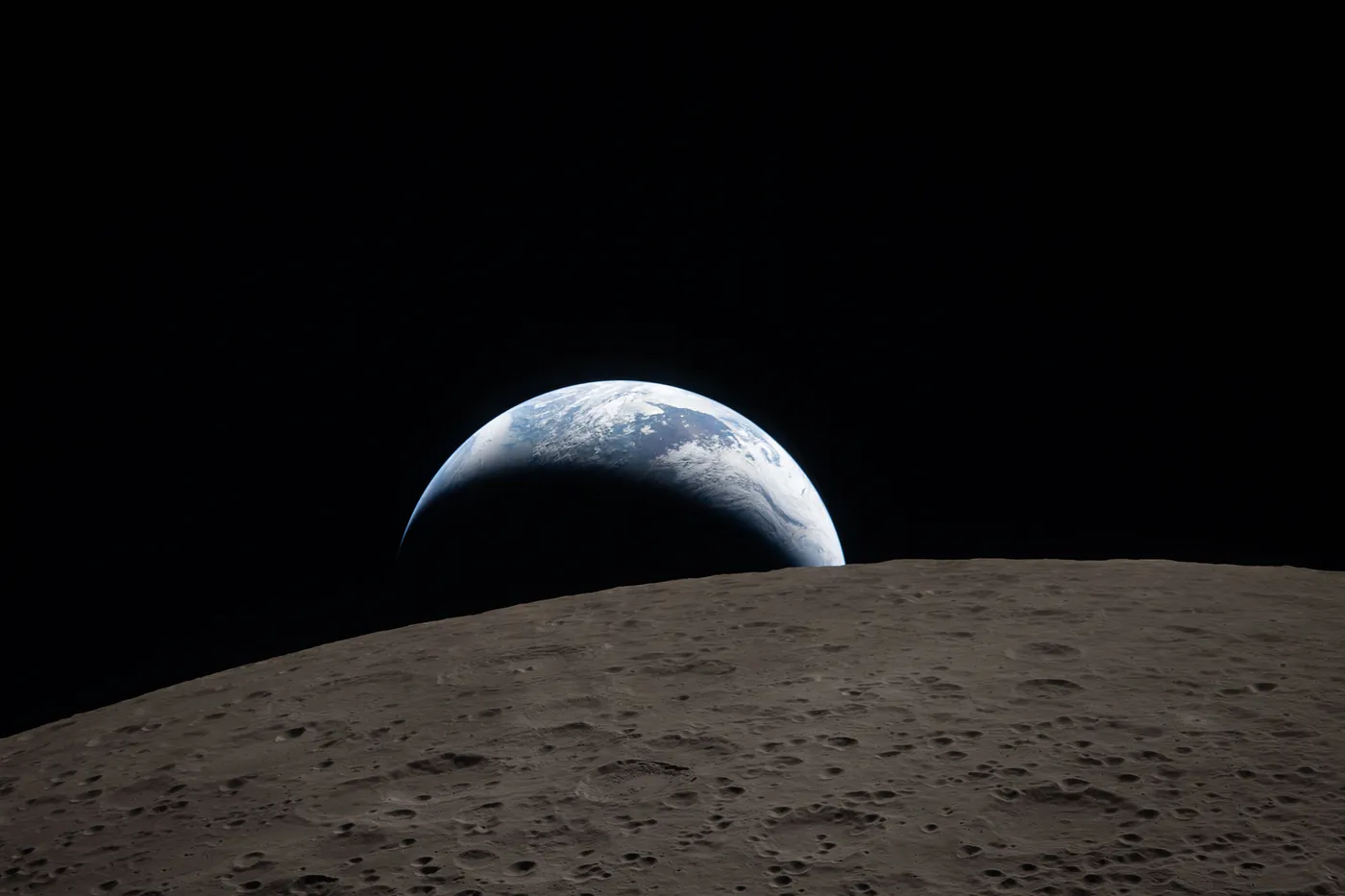
This beautiful image of Earth from beyond the Moon was taken by the Artemis II crew as they flew around the Moon on April 6, 2026 — making them the first humans to fly around the Moon since 1972. The image is known as “Earth set” because they were watching Earth appear to set below the Moon as they flew past.
Please Also See:
- Astronaut reading of Max Goes to the Moon for Story Time From Space.
- The Max Goes to the Moon movie, which can be streamed online (Spanish version also available):
- Article: “How My Dog Made it to Orbit”
- More about the book Max Goes to the Moon
