
 |
|
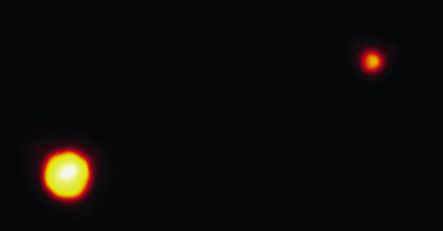
Pluto and Charon, as photographed by the Hubble Space Telescope. Because no spacecraft has been to Pluto, we do not yet have clear pictures of this tiny planet or its moon. |
At its average distance from the Sun, the model Pluto lies another 140 meters beyond Neptune. The grapefruit-size Sun, more than a half kilometer away, appears tiny from here. It is easy to imagine that the world of Pluto must be cold and dark.
One look at the model Pluto, along with its moon Charon, shows it to be out of character with the rest of the planets. Pluto is neither large and gaseous like the other planets of the outer solar system nor rocky like the planets of the inner solar system. Instead, it is very small--the smallest planet by far--and is made mostly of ices. Pluto's orbit is also unusual. Whereas all the other planets orbit the Sun along nearly circular paths and in nearly the same plane, Pluto's orbit is highly elongated and substantially inclined relative to the orbits of the other planets. Pluto actually comes closer to the Sun than Neptune for 20 years of each 284-year orbit. The last such period ended in 1999, so the next won't begin until 2263.
Although Pluto's characteristics make it a "misfit" among the planets, they give it much in common with the only other inhabitants of the outskirts of the solar system: the balls of ice and dust we call comets. In the past decade or so, astronomers have discovered many other Pluto-like objects, though none quite as large as Pluto. Indeed, it now seems likely that Pluto is merely the largest (or one of the largest) among thousands of "giant comets" that orbit the Sun beyond Neptune. Some astronomers have gone so far as to suggest demoting Pluto from its status as a planet, but most favor keeping its popular title as the ninth planet--a title it has held since its discovery in 1930 by Clyde Tombaugh.
 |
|
This map shows Pluto's location in the Voyage scale model solar system on the National Mall in Washington, DC. The dot at the top of the page (next to title) shows Pluto's size on the scale. |