
 |
 |
|
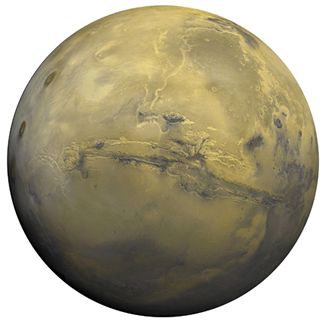
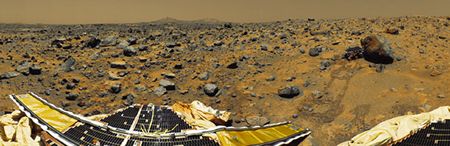
The surface of Mars, photographed from NASA's Pathfinder lander in 1997; part of the lander is visible in the foreground. The little rover called Sojourner is in the upper right, studying a rock that scientists dubbed Yogi. The inset (right) shows the full disk of Mars; the "gash" going horizontally across the center is the giant canyon known as Valles Marineris. |
A few more steps take us to the model Mars, which is about half the size (diameter) of Earth. Mars has two tiny moons, Phobos and Deimos, but they are so small as to be microscopic on our 1-to-10-billion scale.
Mars is a world of wonders, with extinct volcanoes that dwarf the largest mountains on Earth, a great canyon that runs nearly one-fifth of the way around the planet, and polar caps made of frozen carbon dioxide ("dry ice") and water ice. Although Mars is frozen today, the presence of dried-up riverbeds and rock-strewn floodplains offers clear evidence that Mars was warm and wet sometime in the distant past. Thus, Mars may once have been hospitable for life, though its wet era probably ended at least 3 billion years ago.
Mars looks almost Earth-like in photographs taken by spacecraft on its surface, but you wouldn't want to visit without a space suit. The air pressure is far less than that on top of Mount Everest, the temperature is usually well below freezing, the trace amounts of oxygen would not be nearly enough to breathe, and the lack of atmospheric ozone would leave you exposed to deadly ultraviolet radiation from the Sun.
Mars is the most studied planet besides Earth. More than a dozen spacecraft have flown past, orbited, or landed on Mars, and plans are in the works for many more. We may even send humans to Mars within our lifetime. Overturning rocks in ancient riverbeds or chipping away at ice in the polar caps, explorers will search for fossil evidence of past life--and perhaps even find a few places where microbes survive today.
 |
|
This map shows Mars's location in the Voyage scale model solar system on the National Mall in Washington, DC. The dot at the top of the page (next to title) shows Mars's size on the scale. |